Understanding How Landfills Operate: An Essential Part of Waste Management

Waste disposal has been a challenge for humans for centuries, but the modern landfill plays a crucial role in managing our trash. While most of us are familiar with the concept of landfills, it’s easy to overlook the complex processes involved in their operation. So, how do landfills work, and what makes them effective at handling our waste?
What Is a Landfill?
In its simplest form, a landfill is a designated site where trash is dumped and stored. However, modern landfills are not just simple waste dumps. They are carefully designed and regulated facilities that ensure waste is disposed of in a way that minimizes harm to the environment. These facilities are equipped to manage solid waste responsibly, with various features designed to contain harmful substances and protect the surrounding areas from contamination.
Key terms related to landfills include:
- Leachate: A toxic liquid that forms as waste decomposes, often containing harmful chemicals.
- Cell: A specific section of the landfill where waste is deposited.
- Groundwater: Water beneath the surface that can be contaminated by pollutants if not properly managed.
- Anaerobic decomposition: The breakdown of organic waste without oxygen, producing gases like methane.
- Greenhouse gases: Gases emitted during waste decomposition, which contribute to global warming.
- Flaring: The process of burning methane to convert it into less harmful substances like carbon dioxide.
The Difference Between a Landfill and a Dump
While the terms “landfill” and “dump” are often used interchangeably, there’s a significant difference. Dumps were the earlier, less regulated waste disposal sites, often causing environmental harm due to the lack of protective measures. In contrast, landfills today are carefully designed to prevent toxic materials from leaching into the environment. They are subject to strict regulations to ensure proper waste management.
The Evolution of Landfills
Historically, communities relied on dumps for waste disposal, with some dating back thousands of years. However, these early waste management practices were far from ideal, often resulting in contamination of soil and water supplies. By the mid-20th century, the need for more structured waste management led to the development of modern landfills. Laws were introduced to regulate waste disposal, with the passage of the Solid Waste Disposal Act in 1965, and later, the Resource Conservation and Recovery Act (RCRA) in 1976, setting guidelines for landfill construction and operation.
How Modern Landfills Are Built
Modern landfills are designed with several layers to protect the environment. While each landfill may differ slightly in its construction, they generally follow the same basic principles:
- Bottom Liner: A thick protective layer at the base of the landfill to prevent leachate from contaminating soil and groundwater.
- Cells: Divided sections within the landfill where waste is placed.
- Leachate Collection System: A system to capture harmful liquids formed during decomposition.
- Stormwater Drainage: A system to manage rainwater runoff and prevent excess water from entering the landfill.
- Groundwater Monitoring: Systems that track the quality of nearby groundwater to detect any contamination.
- Gas Collection System: Designed to capture gases like methane produced during waste decomposition, preventing them from escaping into the atmosphere.
A layer of soil or other material is often placed over the landfill at the end of each day to prevent odors and deter wildlife.
The Four Key Layers of a Landfill
Landfills are constructed with a four-layer system to prevent environmental contamination:
- Protective Liners: Made of clay and plastic to block out water and leachate.
- Drainage Layer: Helps collect leachate, which is then treated before being safely released.
- Gas Collection: A series of pipes collects gas emissions from decomposing waste, which can be used for energy or safely burned.
- Trash: The waste itself, which is compacted daily to maximize space and minimize environmental impact.
What Happens to Waste in a Landfill?
When trash is delivered to a landfill, it undergoes several processes:
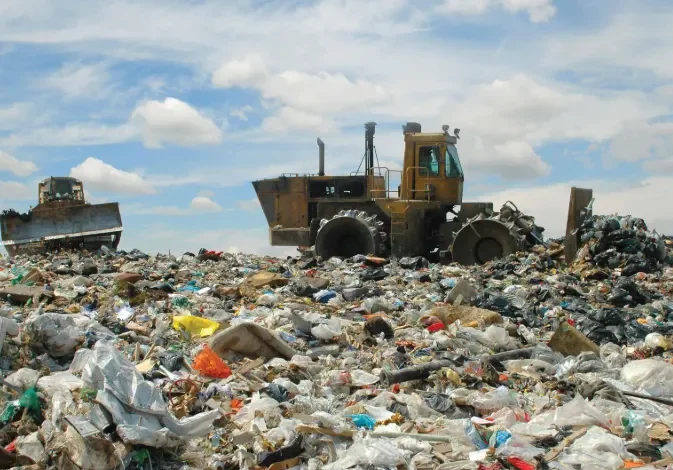
- Tipping: Waste is unloaded into the landfill and spread across the designated cell.
- Compaction: The waste is compacted to make efficient use of the available space.
- Daily Cover: A layer of soil is placed over the trash to control odors and prevent pests from accessing the waste.
Types of Landfills
There are different types of landfills based on the waste they handle:
- Municipal Solid Waste Landfills (MSWLFs): These are the most common, dealing with everyday household waste.
- Bioreactor Landfills: A specific type of MSWLF that accelerates the decomposition of organic waste.
- Industrial Waste Landfills: Used to dispose of industrial byproducts.
- Hazardous Waste Landfills: For the disposal of toxic or hazardous materials.
Can Landfills Ever Be Full?
Landfills do have a finite capacity. Once a landfill reaches its maximum capacity, it is closed and capped to prevent contamination. A layer of plastic and soil is placed over the site, and vegetation is planted to help stabilize the ground. Some closed landfills are repurposed for other uses, such as parks, solar farms, or even residential developments.
The Future of Landfills
With growing concerns over waste management, alternative solutions are being explored to reduce our reliance on landfills. Landfill mining is one such approach, involving the excavation of old landfills to recover recyclable materials. Other strategies include recycling, composting, and reducing waste through more sustainable practices.
As the world continues to produce more waste, finding sustainable solutions to landfill management will be crucial. For now, modern landfills remain an essential part of waste management systems, providing a controlled way to dispose of the trash we generate.